

UNMIRI Launches a Literature Intelligence Platform for Oncology Medical Affairs
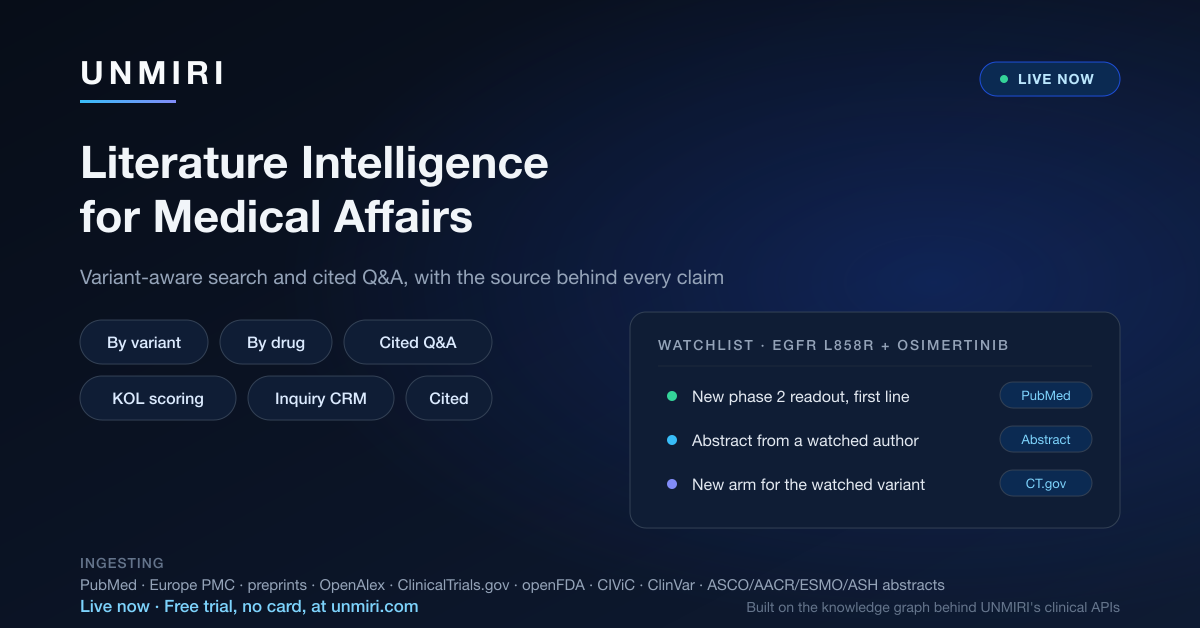
UNMIRI's literature intelligence platform is live for oncology medical affairs: variant-aware search, cited digests, KOL scoring, and an inquiry CRM, with a free trial.
Variant-aware search, cited Q&A, KOL intelligence, and inquiry CRM for oncology medical affairs. Free trial plus individual, team, and enterprise plans
LANGHORNE, PA, UNITED STATES, June 29, 2026 /EINPresswire.com/ -- UNMIRI LLC today launched its literature intelligence and key-opinion-leader platform for oncology medical affairs teams. It is live now: a medical affairs professional can sign up at unmiri.com, start a free trial with no credit card and no sales call, and run a first watch list the same day. Paid plans are available for individual users, teams, and enterprise workspaces.
Medical affairs teams spend much of their week watching the literature: new publications, conference abstracts, label changes, trial readouts, and the experts behind them. Most tools built for that work cover all of biology and are priced for the largest organizations. UNMIRI built this for the teams in between, the medical affairs and MSL groups at oncology biotechs who need depth on the handful of genes, drugs, and competitors that touch their products.
Search is variant-aware. A query for EGFR L858R in lung cancer fans out across the forms the variant actually appears under in PubMed (L858R, p.L858R, Leu858Arg) and the synonyms a tumor type hides behind, so a paper indexed under non-canonical phrasing still surfaces. Results are ranked by recency, citation count, study type, how directly each article addresses the query, and whether the article is already cited in curated public knowledge bases such as CIViC and ClinVar. Full text is used only from open-access articles whose licenses permit it; everything else contributes its abstract. Behind the search is a continuously updated index of PubMed, Europe PMC, bioRxiv and medRxiv preprints, OpenAlex, ClinicalTrials.gov, openFDA drug labels and adverse-event signals, and conference abstracts tracked through Crossref as they post against the supplements for ASCO, AACR, ESMO, ASH, WCLC, SABCS, and EHA.
Summaries are written by a language model under strict rules and labeled as such. Every claim cites the PubMed IDs behind it, a verbatim guard keeps the output paraphrased rather than copied, and a second model pass checks each claim against its cited sources and drops anything unsupported. Each claim carries a confidence label tied to the strength of the evidence, so a Phase 3 readout and a case report never blur together. When the evidence is thin, the system says so instead of filling the gap with confident prose. The output is reference material for professionals, not clinical advice.
The platform turns that surveillance into fieldwork. It surfaces and ranks the key opinion leaders for an indication using a transparent composite of OpenAlex citation data, ORCID and ROR identifiers, and congress activity. Teams log their interactions with those experts, build MSL pre-call and congress-prep packs, assemble advisory-board briefings from their workspace, and run medical inquiries through a question-to-cited-response workflow whose drafts stay human-review-only and are never auto-sent. Team and enterprise workspaces share watch lists and KOL history across seats, with export to markdown and docx, and an optional Salesforce connection, enabled per organization, for teams that manage inquiries there.
"Medical affairs lives in the literature, and the tooling has never quite fit the work," said Umair Khan, co-founder and CTO of UNMIRI. "We built something that tracks the research the way these teams actually think about it, by variant, by drug, by the people publishing, and shows the source behind everything so nothing has to be taken on faith."
The platform runs on the same foundation as UNMIRI's clinical APIs: a typed knowledge graph over public oncology sources, with every output traceable to a citable source. It is one of several surfaces on UNMIRI's precision oncology platform, alongside cross-vendor NGS interpretation, genomics-aware clinical decision support, variant-grounded trial matching, and prior-authorization decisions.
The free trial is open now at https://unmiri.com.
About UNMIRI
UNMIRI LLC builds precision oncology infrastructure that healthcare software companies, biotech medical affairs teams, and clinicians can verify. Its cross-vendor APIs normalize next-generation sequencing reports into citation-grounded clinical data using a knowledge-graph architecture and deterministic output. Founded in 2023 and based in Langhorne, Pennsylvania, UNMIRI is led by CEO Nida Uddin and CTO Umair Khan. Learn more at https://unmiri.com.
Umair Khan
UNMIRI LLC
press@unmiri.com
Visit us on social media:
LinkedIn
Instagram
Facebook
X
Legal Disclaimer:
EIN Presswire provides this news content "as is" without warranty of any kind. We do not accept any responsibility or liability for the accuracy, content, images, videos, licenses, completeness, legality, or reliability of the information contained in this article. If you have any complaints or copyright issues related to this article, kindly contact the author above.
