

Liquid ring vacuum pump working principle
A liquid ring vacuum pump is one of the most reliable vacuum technologies used in modern industry. From chemical processing and pharmaceutical production to new materials and energy applications, liquid ring vacuum pumps are widely selected for handling wet gases, condensable vapors, and corrosive process streams.
Unlike dry vacuum pumps, a liquid ring vacuum pump uses a sealing liquid—typically water—to create the vacuum. This simple yet robust design allows it to operate continuously in demanding industrial environments where moisture, solvent vapors, and process contaminants are present.
In this article, we explain the liquid ring vacuum pump working principle, key components, operating cycle, advantages, and typical industrial applications.
What Is a Liquid Ring Vacuum Pump?
A liquid ring vacuum pump is a rotary positive displacement vacuum pump.
Its operation is based on a rotating impeller mounted eccentrically inside a cylindrical casing partially filled with sealing liquid. As the impeller rotates, centrifugal force forms a liquid ring against the inner wall of the casing.
The space between the impeller blades and the liquid ring creates variable-volume chambers that continuously perform suction, compression, and discharge during each revolution.
This operating principle makes liquid ring vacuum pumps especially suitable for handling:
Wet gases
Condensable vapors
Solvent recovery processes
Corrosive gases
Dust-laden gas streams
Main Components of a Liquid Ring Vacuum Pump
A typical liquid ring vacuum pump consists of:
1. Impeller
The impeller is mounted eccentrically within the pump casing and rotates at high speed.
2. Pump Casing
The cylindrical housing contains the sealing liquid and supports the formation of the liquid ring.
3. Seal Liquid
Water is the most commonly used operating liquid, although other compatible liquids can be used depending on the process requirements.
4. Suction Port
Process gas enters the pump through the inlet port.
5. Discharge Port
Compressed gas is discharged through the outlet port.
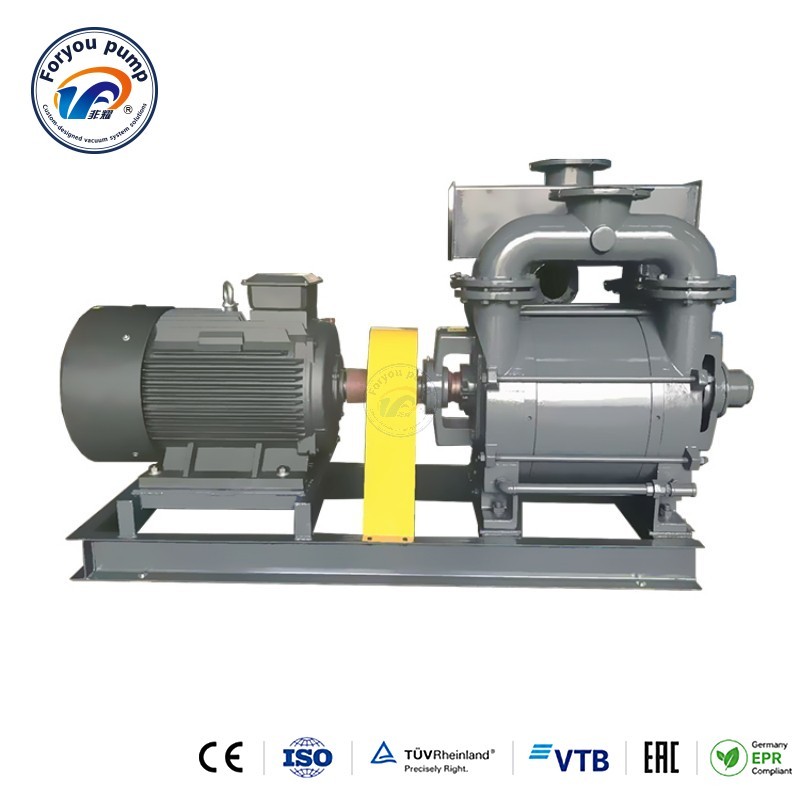
2BE water ring vacuum pump
2BE1 Water-ring Vacuum Pump Electric Unit
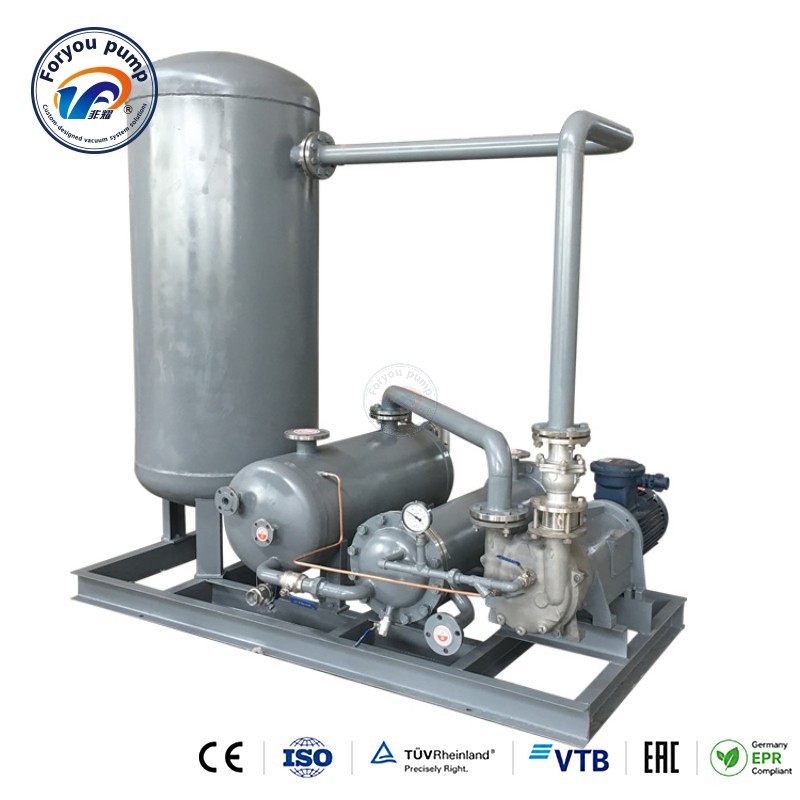
2BV2061 Explosion proof Variable Frequency Water Ring Vacuum Pump Closed Loop Unit
Liquid Ring Vacuum Pump Working Principle
Step 1: Formation of the Liquid Ring
When the pump starts operating, the impeller rotates inside the casing.
Due to centrifugal force, the operating liquid is pushed outward toward the casing wall, forming a stable liquid ring.
Because the impeller is installed eccentrically, the liquid ring is not concentric with the impeller.
This eccentric arrangement is the key to generating vacuum.
Step 2: Suction Phase
As the impeller rotates, the spaces between adjacent blades increase in volume on the suction side.
The expanding chamber creates a pressure drop.
As pressure decreases below system pressure, gas is drawn into the pump through the suction port.
Step 3: Compression Phase
As rotation continues, the chamber volume gradually decreases.
The trapped gas becomes compressed between the liquid ring and impeller blades.
Because the sealing liquid absorbs much of the heat generated during compression, the process is relatively close to isothermal compression.
This characteristic is particularly beneficial when handling solvent vapors and temperature-sensitive gases.
Step 4: Discharge Phase
When the gas pressure inside the chamber reaches the discharge pressure, the gas exits through the discharge port.
The cycle then repeats continuously with each impeller revolution.
The entire process consists of:
Suction
Compression
Discharge
These three stages occur simultaneously in different chambers around the impeller.
2BW closed-loop circulation system
Air cooled water ring vacuum pump
JZJ600 Roots Pump Reciprocating Vacuum Pump Unit
Why Are Liquid Ring Vacuum Pumps Ideal for Chemical and Pharmaceutical Industries?
Many industrial vacuum technologies struggle when exposed to:
Moisture
Solvent vapors
Corrosive gases
Process carryover
Liquid ring vacuum pumps excel in these conditions because the operating liquid acts as both a seal and a cooling medium.
Key benefits include:
Excellent Vapor Handling
The pump can handle saturated gases and condensable vapors without performance loss.
Reliable Operation
No metal-to-metal contact exists inside the pumping chamber.
This reduces wear and extends service life.
Safe for Hazardous Processes
Liquid ring pumps are commonly used in applications involving flammable and explosive gases.
Stable Vacuum Performance
Even under fluctuating process conditions, vacuum levels remain stable and predictable.
LGB20 screw vacuum pump unit
Roots pump water ring vacuum pump unit
Vacuum automatic drainage tank
Common Applications of Liquid Ring Vacuum Pumps
Chemical Processing
Vacuum distillation
Solvent recovery
Reactor evacuation
Crystallization
Pharmaceutical Manufacturing
Vacuum drying
Filtration
Solvent extraction
API production
New Material Industry
Degassing
Vacuum impregnation
Material drying
Energy Industry
Battery material processing
Vacuum dehydration
Gas recovery systems
Single-Stage vs. Two-Stage Liquid Ring Vacuum Pumps
Single-Stage Liquid Ring Vacuum Pump
Advantages:
Simpler structure
Lower investment cost
Easy maintenance
Suitable for:
General industrial vacuum applications
Two-Stage Liquid Ring Vacuum Pump
Advantages:
Higher vacuum levels
Better efficiency at low pressures
Improved process stability
Suitable for:
Chemical plants
Pharmaceutical facilities
Solvent recovery systems
How to Select the Right Liquid Ring Vacuum Pump
Before selecting a pump, consider:
Required vacuum level
Gas composition
Vapor content
Operating temperature
Process pressure
Corrosion requirements
Flow rate
For demanding chemical and pharmaceutical applications, a complete vacuum system often provides better efficiency than a standalone pump.
Why Choose FORYOU Vacuum Pump?
At FORYOU, we specialize in vacuum solutions for chemical, pharmaceutical, new material, and energy industries.
Our product range includes:
2BV Liquid Ring Vacuum Pumps
2BE Liquid Ring Vacuum Pumps
Water Ring Vacuum Pump Systems
Screw Vacuum Pumps
Roots Vacuum Pumps
With years of manufacturing experience and customized engineering capabilities, we help industrial customers build reliable vacuum systems tailored to their production processes.
Water ring vacuum pump closed-loop unit
Water ring vacuum pump closed-loop unit
ZJQ600 air-cooled Roots vacuum pump
Conclusion
The liquid ring vacuum pump working principle is based on a simple yet highly effective concept: using a rotating liquid ring to create variable-volume chambers for suction, compression, and discharge.
Its ability to handle wet gases, condensable vapors, and challenging process conditions makes it one of the most widely used vacuum technologies in chemical, pharmaceutical, new material, and energy industries.
When reliability, process stability, and long service life are critical, liquid ring vacuum pumps remain one of the most trusted solutions available.
Anhui Foryou Vacuum Technology Co., Ltd.
Anhui Foryou Vacuum Technology Co., Ltd.
+86 180 9640 4767
blair@foryoupump.com
Legal Disclaimer:
EIN Presswire provides this news content "as is" without warranty of any kind. We do not accept any responsibility or liability for the accuracy, content, images, videos, licenses, completeness, legality, or reliability of the information contained in this article. If you have any complaints or copyright issues related to this article, kindly contact the author above.
