

Advanced Driver Assistance Systems Market to Reach USD 120.53 Billion by 2035, Growing at 13.0% CAGR
Advanced Driver Assistance Systems Market
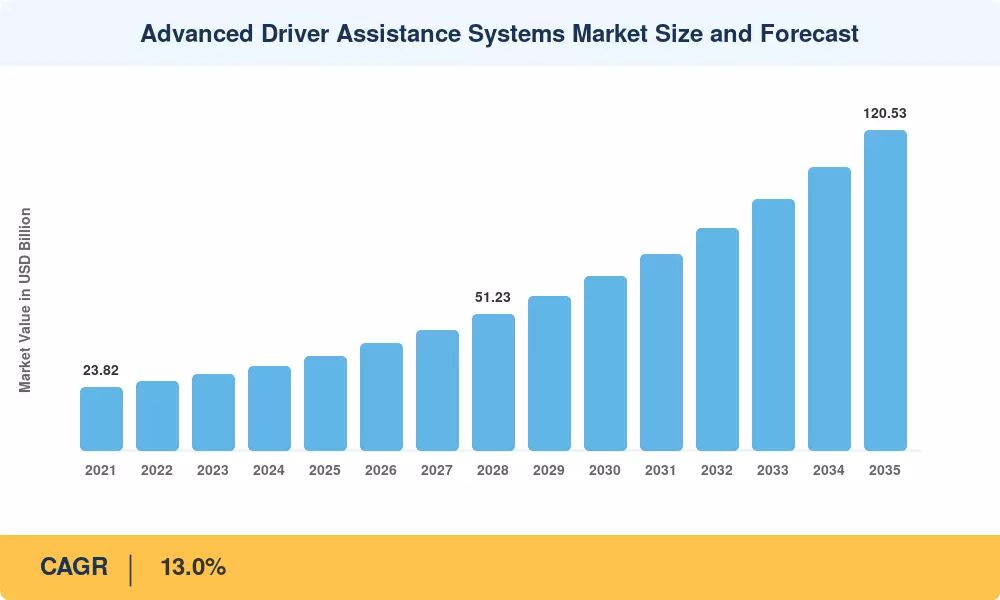
ADAS Market reached an estimated USD 35.50 Billion in 2025 and is projected to climb from USD 40.12 Billion in 2026 to USD 120.53 Billion by 2035
NEW YORK, NY, UNITED STATES, August 21, 2026 /EINPresswire.com/ -- According to a study from Market Research Future, Advanced Driver Assistance Systems Market reached an estimated USD 35.50 Billion in 2025 and is projected to climb from USD 40.12 Billion in 2026 to USD 120.53 Billion by 2035, registering a CAGR of 13.0% across the forecast 2026 to 2035, driven by Integration of artificial intelligence enhances safety.Market Overview
The Advanced Driver Assistance Systems Market represents one of the most dynamic and rapidly growing segments within the global automotive industry, encompassing a comprehensive portfolio of electronic systems and technologies designed to enhance vehicle safety, improve driver comfort, and pave the way for autonomous driving. Advanced Driver Assistance Systems (ADAS) include a wide range of safety and convenience features such as adaptive cruise control, automatic emergency braking, lane-keeping assist, blind spot detection, parking assist systems, adaptive front-lighting, and night vision systems. These systems utilize an array of sensors including radar, cameras, LiDAR, and ultrasonic sensors to perceive the vehicle's environment, process this information through sophisticated algorithms, and either assist the driver in decision-making or take autonomous actions to prevent collisions and enhance safety. The integration of artificial intelligence in ADAS systems has revolutionized their capabilities, enabling more accurate perception, predictive behavior modeling, and adaptive responses to complex driving scenarios.
The market's robust growth trajectory at a compound annual growth rate of 13.0% is underpinned by several critical drivers. The most significant driver is the global imperative to reduce road traffic accidents and fatalities, with ADAS technologies proven to significantly reduce the frequency and severity of collisions. Regulatory mandates across major markets, including the European Union's General Safety Regulation and the United States' New Car Assessment Program, are requiring the inclusion of ADAS features such as automatic emergency braking, lane departure warning, and driver monitoring systems in new vehicles. Consumer demand for enhanced vehicle safety and convenience features has also accelerated ADAS adoption, with these systems increasingly becoming key differentiators in vehicle purchasing decisions. Furthermore, the progression toward higher levels of vehicle autonomy has made ADAS technologies essential building blocks for autonomous driving capabilities.
Several significant industry trends are reshaping the ADAS landscape. The trend toward sensor fusion, where data from multiple sensor types is combined to create a comprehensive understanding of the vehicle's environment, is enabling more robust and reliable ADAS functionality. The integration of artificial intelligence and deep learning algorithms has dramatically improved the capabilities of ADAS systems, enabling more accurate object detection, classification, and behavior prediction. The trend toward more advanced levels of autonomy, moving from Level 1 and Level 2 systems toward Level 3 and beyond, is driving the development of increasingly sophisticated ADAS technologies. Additionally, the trend toward more affordable ADAS solutions, enabled by economies of scale and technological advancements, is expanding the addressable market to include economy and entry-level vehicle segments.
Technological developments in the ADAS sector are advancing rapidly across multiple fronts. The development of high-resolution imaging radar and advanced LiDAR systems is providing more detailed environmental perception, particularly in challenging conditions such as adverse weather and low visibility. The emergence of 4D imaging radar, which provides velocity information in addition to range, azimuth, and elevation, offers enhanced object detection and classification capabilities. Camera technology continues to evolve, with higher resolution sensors and improved low-light performance enabling more accurate perception. Machine learning algorithms are becoming more sophisticated, with improved ability to detect and classify objects, predict behavior, and make safe driving decisions. Furthermore, the development of more powerful and efficient computing platforms is enabling the processing of the vast amounts of sensor data required for advanced ADAS functionality.
Government policies and regulatory frameworks play a crucial role in shaping the ADAS market. The European Union's General Safety Regulation, which mandates a range of ADAS features including intelligent speed assistance, driver drowsiness and attention warning, and emergency lane-keeping systems for new vehicles from 2022, has created substantial demand for ADAS technologies. The United States' New Car Assessment Program has been updated to include tests for ADAS features, incentivizing manufacturers to include these technologies to achieve favorable safety ratings. China's automotive safety regulations have also been evolving to require ADAS features in new vehicles. Furthermore, the development of regulatory frameworks for autonomous vehicles, including testing and deployment requirements, is driving investment in advanced ADAS capabilities that will serve as foundations for fully autonomous systems.
The demand outlook for ADAS systems remains exceptionally strong, with projections indicating sustained robust growth throughout the forecast period. The increasing penetration of ADAS features across all vehicle segments, from luxury to economy, is expanding the addressable market. The commercial vehicle sector represents a significant growth area, with fleet operators increasingly adopting ADAS technologies to enhance safety, reduce accidents, and lower insurance costs. The two-wheeler segment, particularly in Asia-Pacific, is emerging as a new market for ADAS technologies. The aftermarket for ADAS systems and components also presents growing opportunities as vehicle owners seek to upgrade older vehicles with modern safety features.
📍 Get Free Sample Report for Detailed Market Insights:
https://www.marketresearchfuture.com/sample_request/4434
Market Segmentation
The Advanced Driver Assistance Systems Market is comprehensively segmented to provide detailed insights into the various dimensions of this critical and rapidly evolving industry.
By System Type: The market encompasses Adaptive Cruise Control, which maintains a safe distance from preceding vehicles by automatically adjusting speed. Automatic Emergency Braking detects potential collisions and applies brakes to prevent or mitigate impacts. Lane-Keeping Assist helps drivers maintain their lane position by providing steering interventions. Parking Assist Systems use sensors and cameras to guide drivers during parking maneuvers or enable automated parking. Blind Spot Detection monitors areas not visible to the driver and provides warnings of vehicles in adjacent lanes. Adaptive Front-Lighting systems adjust headlight patterns to improve visibility in curves and varying driving conditions. Night Vision Systems enhance visibility in low-light conditions, detecting pedestrians and animals beyond headlight range. Forward Collision Warning alerts drivers to potential front-end collisions. Other Systems include Driver Monitoring, which detects driver drowsiness and distraction, and Traffic-Sign Recognition, which identifies and displays traffic signs to the driver.
By Sensor Type: The market is segmented into Radar, which provides accurate distance and velocity measurements and is widely used for adaptive cruise control and automatic emergency braking. Camera sensors provide detailed visual information for object detection, lane recognition, and traffic sign identification. LiDAR offers high-resolution 3D perception, essential for advanced autonomous driving applications. Ultrasonic sensors provide short-range detection for parking assist and low-speed maneuver applications. The sensor fusion trend, where data from multiple sensor types is combined to provide comprehensive environmental perception, is increasingly prevalent in advanced ADAS systems.
By Vehicle Type: The market is segmented into Passenger Cars, which represent the largest and fastest-growing segment due to high production volumes and increasing consumer demand for safety features. Commercial Vehicles, including light commercial vehicles and heavy trucks, represent a significant growth area as fleet operators recognize the safety and economic benefits of ADAS technologies. Two-Wheelers represent an emerging segment, with ADAS features such as anti-lock braking systems, traction control, and forward collision warning being introduced in premium motorcycle models.
By Level of Autonomy: The market is segmented according to the SAE International levels of driving automation. Level 1 includes systems that provide either steering or acceleration/braking assistance, such as adaptive cruise control. Level 2 includes systems that provide combined steering and acceleration/braking assistance, such as lane keeping and adaptive cruise control combined. Level 3 includes systems that can perform all aspects of driving under certain conditions, with the driver ready to take control. Level 4 includes systems that can perform all driving tasks in specific conditions without driver intervention. Level 5 includes fully autonomous systems that can drive in all conditions without driver intervention. The current market is dominated by Level 1 and Level 2 systems, with higher levels of autonomy expected to grow as technology matures and regulatory frameworks evolve.
By Sales Channel: The market is segmented into OEM-Fitted, where ADAS systems are installed during vehicle manufacturing, representing the largest and most reliable channel for ADAS adoption. The Aftermarket segment provides ADAS systems and components for vehicles not equipped with these features at the factory, or for upgrading existing systems, representing a growing opportunity as consumers seek to enhance vehicle safety.
🛒 You can buy this market report at:
https://www.marketresearchfuture.com/checkout?currency=one_user-USD&report_id=4434
Regional Analysis
North America represents a significant and mature market for ADAS, driven by strong consumer demand for vehicle safety features, a robust regulatory environment, and the presence of major automotive manufacturers and technology companies. The United States leads the region, with the National Highway Traffic Safety Administration's New Car Assessment Program and the increasing adoption of ADAS features across all vehicle segments. The region's strong focus on vehicle safety and the growing trend toward autonomous driving have accelerated ADAS adoption. The commercial vehicle sector in North America is also a significant market, with fleet operators increasingly adopting ADAS technologies to enhance safety and reduce liability.
Europe holds a substantial share of the global ADAS market, benefiting from the region's leadership in automotive safety regulation and its position as a center of automotive manufacturing and innovation. The European Union's General Safety Regulation, which mandates a range of ADAS features for new vehicles, has created substantial and sustained demand for ADAS technologies. European automotive manufacturers have been at the forefront of ADAS innovation, with many advanced safety features originating in the region. The region's strong focus on reducing road fatalities and the progression toward autonomous driving continue to drive ADAS adoption and innovation.
Asia-Pacific represents the fastest-growing market for ADAS, driven by the region's dominant position in global vehicle production, rapidly increasing vehicle ownership, and growing consumer demand for safety features. China, the world's largest automotive market, has been implementing regulations that encourage ADAS adoption and has seen rapid growth in ADAS-equipped vehicles. Japan and South Korea, home to major automotive manufacturers, have been investing heavily in ADAS technologies. The region's large and growing passenger vehicle market, combined with increasing awareness of vehicle safety, creates substantial opportunities for ADAS growth.
Rest of the World, including South America, the Middle East, and Africa, represents emerging markets with growing ADAS adoption. While these regions currently account for a smaller share of the global market, they offer substantial long-term potential as vehicle ownership increases and safety awareness grows. The commercial vehicle sectors in these regions represent significant opportunities for ADAS adoption, particularly for fleet operators seeking to enhance safety and operational efficiency.
Competitive Landscape
The ADAS market features intense competition among a diverse range of global players, including established automotive suppliers, technology companies, sensor manufacturers, and specialized ADAS developers. Key players include Bosch GmbH, Continental AG, Denso Corporation, Aptiv PLC, Valeo SA, ZF Friedrichshafen AG, Magna International, Veoneer Inc., Mobileye (Intel Corporation), and NVIDIA Corporation. These companies compete on factors including technological innovation, product quality, integration capabilities, cost competitiveness, and relationships with automotive manufacturers.
Strategic developments in the market have been characterized by significant investment in research and development, strategic partnerships and collaborations, and acquisitions to expand capabilities and market presence. The development of integrated ADAS platforms that combine multiple sensor types with advanced processing and software capabilities is a key focus area for leading players. The increasing importance of artificial intelligence and machine learning in ADAS has prompted companies to invest in AI capabilities and establish partnerships with AI technology providers.
Market positioning varies among players, with some companies focusing on specific ADAS technologies or sensor types, while others offer comprehensive ADAS portfolios covering multiple systems and applications. The trend toward platform-based ADAS solutions, where integrated systems can be adapted across multiple vehicle models and platforms, is gaining traction as automotive manufacturers seek to reduce complexity and improve cost efficiency.
Latest Industry News & Developments
Recent developments in the ADAS industry highlight the rapid pace of innovation and the strategic moves by leading players. Major automotive manufacturers have announced significant investments in ADAS capabilities, including the development of advanced sensor suites and AI-powered perception systems. The trend toward higher levels of autonomy has driven investment in more sophisticated ADAS technologies, including high-resolution imaging radar, solid-state LiDAR, and advanced camera systems.
The industry has witnessed significant advancements in sensor technology, with the introduction of 4D imaging radar that provides velocity information and enhanced object detection capabilities. Solid-state LiDAR systems, offering improved reliability and reduced cost compared to mechanical systems, are becoming increasingly available for automotive applications. High-resolution camera systems with improved low-light performance and dynamic range are enhancing the perception capabilities of ADAS systems.
Another significant development is the increasing focus on ADAS safety validation and testing, with companies developing comprehensive testing programs to ensure the reliability and safety of ADAS systems. The use of simulation and digital twin technologies is enabling more efficient and comprehensive testing of ADAS systems, reducing the time and cost required for validation.
Market Challenges & Opportunities
Despite the strong growth prospects, the ADAS market faces several significant challenges. The complexity of ADAS systems, with their multiple sensors, sophisticated algorithms, and integration with vehicle systems, creates substantial engineering challenges. Ensuring the reliability of ADAS systems across diverse and challenging driving conditions requires extensive testing and validation. The cost of ADAS components, particularly advanced sensors such as LiDAR, can be prohibitive for entry-level vehicle segments, limiting market penetration. Additionally, the increasing reliance on software and connectivity for ADAS functionality introduces cybersecurity concerns that must be addressed.
To explore more market insights, visit us at:
https://www.marketresearchfuture.com/reports/advanced-driver-assistance-systems-market-4434
Final Market Summary
The Advanced Driver Assistance Systems Market is on a strong growth trajectory, projected to increase from USD 40.12 Billion in 2026 to USD 120.53 Billion by 2035, reflecting a compound annual growth rate of 13.0%. This robust growth reflects the fundamental transformation of the automotive industry, where advanced safety and convenience features are becoming essential components of modern vehicles.
More Related Reports from MRFR Library:
Electric Vehicle Battery Recycling Market : https://www.marketresearchfuture.com/reports/electric-vehicle-battery-recycling-market-8326
Public Transport Market : https://www.marketresearchfuture.com/reports/public-transport-market-8677
NVH Testing Market : https://www.marketresearchfuture.com/reports/nvh-testing-market-9753
Automotive Wheel Rims Market : https://www.marketresearchfuture.com/reports/automotive-wheel-rims-market-10101
Motorcycles Market : https://www.marketresearchfuture.com/reports/motorcycles-market-10217
Automotive Brake Shoe Market : https://www.marketresearchfuture.com/reports/automotive-brake-shoe-market-10296
Automotive Semiconductor Market : https://www.marketresearchfuture.com/reports/automotive-semiconductor-market-10444
Intelligent Traffic Management System Market : https://www.marketresearchfuture.com/reports/intelligent-traffic-management-system-market-10756
Luxury Yacht Market : https://www.marketresearchfuture.com/reports/luxury-yacht-market-10884
Cell To Pack Battery Market : https://www.marketresearchfuture.com/reports/cel-to-pack-battery-market-11228
Larry Wilson
WantStats Research And Media Pvt. Ltd.
+1 855-661-4441
email us here
Legal Disclaimer:
EIN Presswire provides this news content "as is" without warranty of any kind. We do not accept any responsibility or liability for the accuracy, content, images, videos, licenses, completeness, legality, or reliability of the information contained in this article. If you have any complaints or copyright issues related to this article, kindly contact the author above.
